The Generation Gap
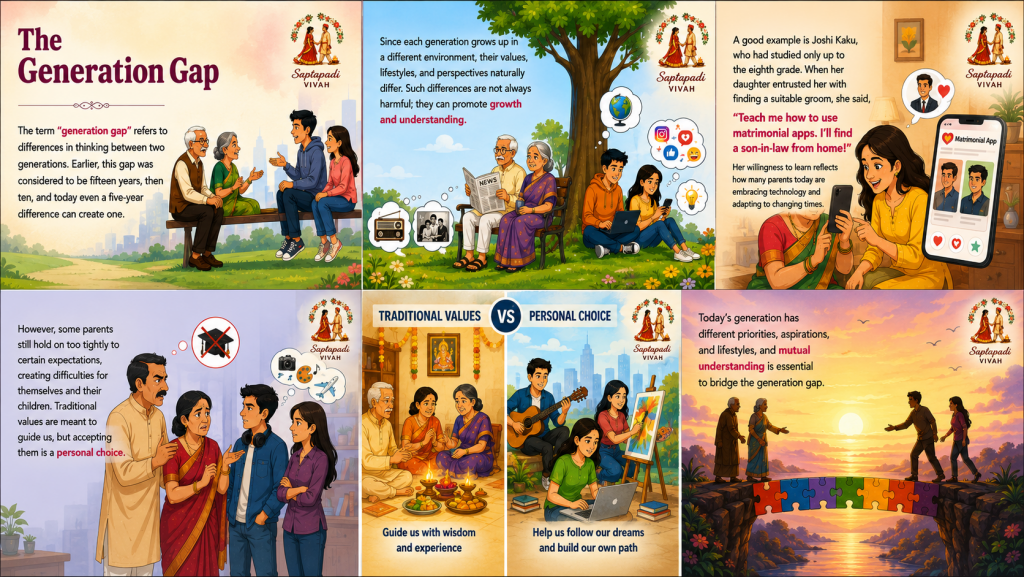
The term "generation gap" is commonly used these days. Earlier, a generation gap was considered to be around fifteen years. Later, it reduced to ten years, and today it feels as if even a five-year difference can create one. But what exactly is a generation gap?
A generation gap is simply the difference in thinking between two generations. These differences may relate to values, traditions, lifestyle choices, fashion, technology, or even perspectives on life itself. Every generation grows up in a different environment, so naturally their thoughts and attitudes differ. When old and new ideas meet, the reactions that follow are often referred to as the generation gap.
Such differences are not always negative. In fact, they can be healthy and productive. However, when it comes to marriage, many pre-marital and post-marital challenges arise because people make decisions based on rigid beliefs and expectations.
If we look at the generation of the 1930s and 1940s—our grandparents and great-grandparents—their thinking was largely traditional because the times demanded it. Boys and girls rarely interacted freely, and in many cases, the bride and groom did not even meet before marriage. They trusted their parents' choice, married the selected partner, and remained committed to that relationship for life. Such was the strength of their values and commitment.
The generation born after the 1950s witnessed tremendous change. While preserving traditions, they also adapted to modern developments. They have seen the world evolve from handwritten letters and community gatherings to smartphones and the internet.
One day, Joshi Kaku visited our office. She had studied only up to the eighth grade, but her enthusiasm for learning new things was remarkable. Her daughter was of marriageable age, and she told us, "My daughter is busy with her office work all day and has given me the responsibility of finding a suitable groom. I don't want to spend hours looking through files of profiles. Instead, teach me how to use those matrimonial apps on the internet. I'll find a son-in-law from home!"
Today, many parents are making sincere efforts to learn new technology and stay connected with changing times. They use smartphones, social media, and online platforms with confidence. However, there are still some parents who unknowingly make life difficult for themselves and their children by holding on too tightly to certain expectations.
Traditional values are meant to guide us and make life better. But accepting those values is a personal choice. No one can be forced to think or live in a particular way—especially today's generation. Their priorities, aspirations, and lifestyles are very different from those of their parents.
Life becomes easier when both generations try to understand each other and find a middle path. But when neither side is willing to adjust, conflicts, misunderstandings, and emotional stress are almost inevitable.
Consider the example of Sachin, a 28-year-old young man with modern views. His parents were searching for a bride for him, and initially, they screened all the profiles. Sachin's mother wanted a daughter-in-law who was completely traditional in her thinking and lifestyle.
However, many young women today dress differently, pursue careers, and have modern outlooks. Because of this, Sachin's mother rejected several excellent proposals, believing the girls were "too modern." On the other hand, whenever she found a very simple and traditional girl, Sachin felt they were not compatible and declined the match.
As a result, years passed, and Sachin's marriage was delayed. Despite being aware of this, the differences in expectations between the two generations remained unresolved.
Dear parents, you are already wise and experienced. But today's changing world requires us to be a little more flexible and open-minded. Many parents have adapted to modern times, but complete acceptance of these changes is still a work in progress.
When that acceptance finally comes, the generation gap will no longer be a distance between two generations. Instead, it will become a beautiful meeting point where experience and fresh thinking come together.
After all, the greatest gift we can offer the next generation is not our opinions, but the maturity and wisdom with which we share them.









Leave a Comment